
This Week's Updates
Alaska Department of Health sent this bulletin at 12/12/2025 02:04 PM AKST
ACoA New Monthly Meetings; Grant Announcements
ACoA Board Meeting Dec. 2 Recap
Thank you to everyone who attended our quarterly board meeting last week including all our great presenters, partners and advocates. You can view a recording of the meeting at these Zoom Cloud links: Part 1 and Part 2. Passcode: aLFi$4KZ. Meeting Minutes will be sent next week, apologies for the delay.
Our next board meeting is in Juneau on February 10th and will be able via Zoom as well. Stay tuned for details.
ACoA Monthly Meeting January 6
ACoA is doing something new and you're invited! In between our quarterly board meetings, we will begin hosting monthly one-hour Zoom meetings beginning January 6th at 9am. We'll be checking in with commissioners on projects including the FY25 Annual Report and the 2025 Senior Snapshot. Public Notice here.
Join the meeting on January 6th at 9am using this link: https://us02web.zoom.us/j/86594583810
Save the Date: ACoA Advocacy Mastery Training with Teri Tibbett January 7 via Zoom
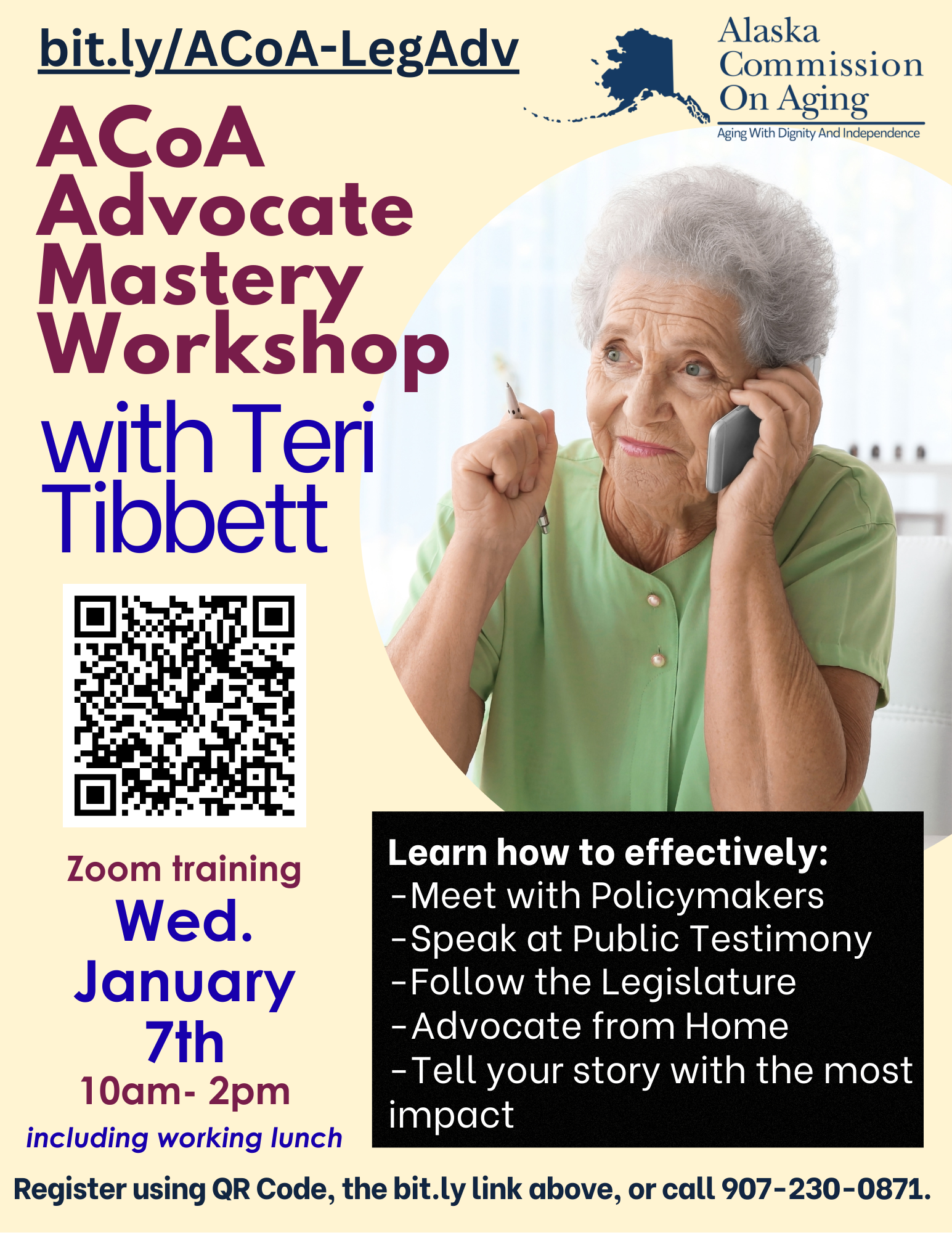
All are welcome! Learn how to be a champion advocate for FREE! This training will cover tips for meeting with policymakers and speaking at public testimony, how to follow the legislature, effective advocacy from home & more! There will be time designated for a working lunch. Join us 10am - 2pm via Zoom. Thank you to Teri Tibbett for making this possible.
Register: https://us02web.zoom.us/webinar/register/WN_eh3tGoDvT6GHpwVCFfEHWw#/registration
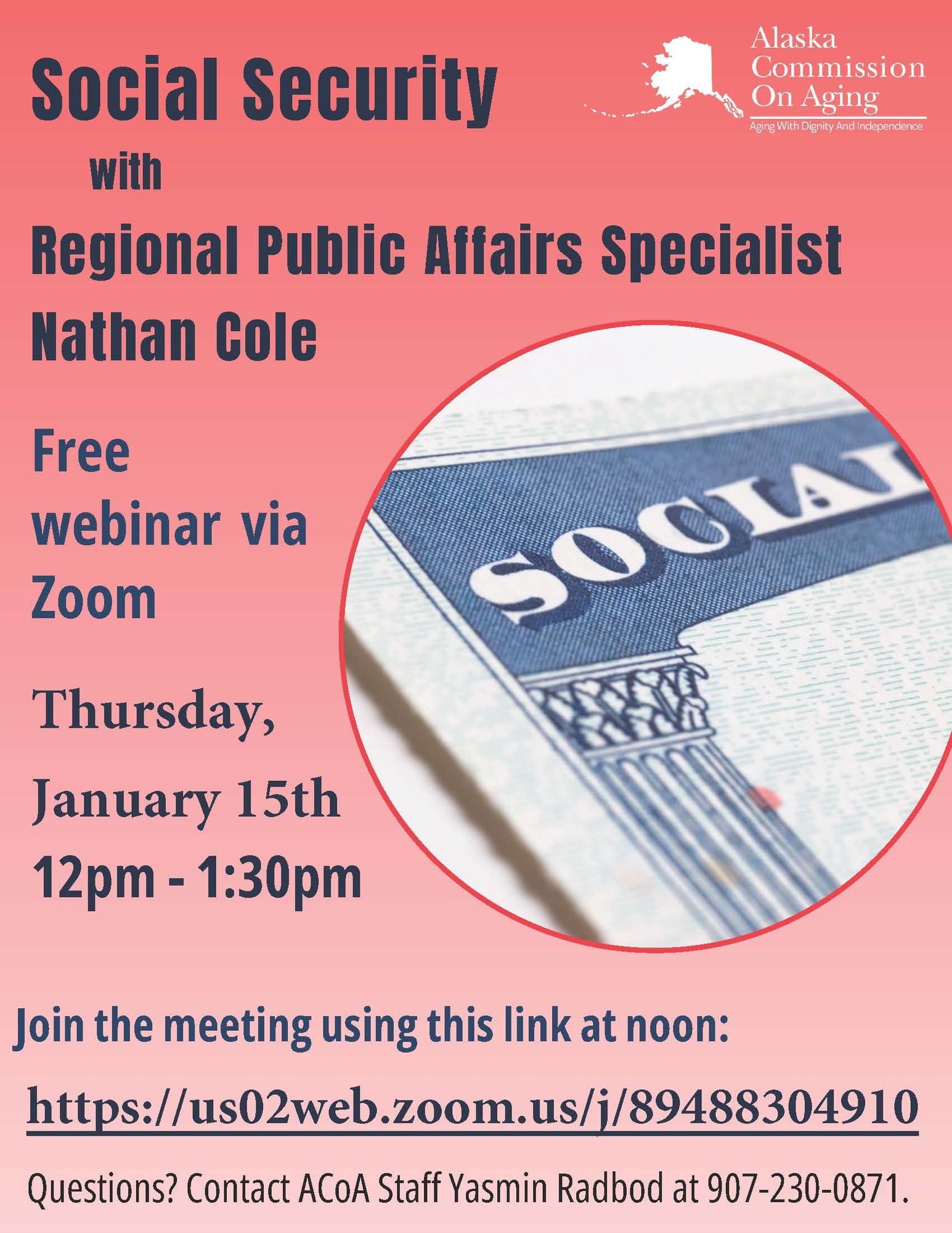
ACoA Webinar: Social Security Administration 101 on January 15
SDS E-Alert: Direct Deposit Coming Soon for Adult Public Assistance and Senior Benefits
Beginning in January 2026, the Division of Public Assistance (DPA) is transitioning away from paper checks for the Adult Public Assistance and Senior Benefits programs to provide a faster, safer, and more reliable way to deliver these monthly payments. Instead of receiving a check in the mail, these benefits will be delivered by direct deposit to a bank account or to an EBT (Alaska Quest) card. This change means no more waiting for the mail or worrying about checks being lost or stolen—just quick, secure access to benefits each month.
Option 1: Direct Deposit to a Bank Account
Direct deposit is the safest and most convenient way to receive benefits. The payment goes directly into a bank account each month, so it’s ready to use without waiting for the mail or visiting the bank.
To sign up, the recipient must complete the Direct Deposit Request Form included with this letter and return it with a voided check or deposit slip. It may take up to 30 days to process the request. Once it’s active, DPA will send the recipient a confirmation notice.
The completed form can be returned in one of the following ways:
- Local Public Assistance office
- Email: hss.dpa.jnu.ebt@alaska.gov
- Fax: (907) 465-3651
- Mail: Division of Public Assistance, P.O. Box 110640, Juneau, AK 99811-0640
Option 2: Deposit onto an EBT (Alaska Quest) Card
If the recipient chooses to get these payments on an Alaska Quest card, there’s nothing more they need to do. Their benefits will be added to the card automatically each month.
Some people already have a Quest card because they receive SNAP (food) benefits. They may still receive a new card because only certain payments can go onto the same card. If a new card is needed, DPA will send it to the recipient in the mail.
Recipients can use the Quest card like a debit card to shop, get cash back, or withdraw money from an ATM. Please note: the card cannot be used at ATMs or point of sale (POS) terminals—also known as checkout machines—located in bars, liquor stores, or places that offer gambling or adult entertainment.
Cards are mailed the next business day after being issued. When the recipient receives the card in the mail, they should follow the instructions to set up a Personal Identification Number (PIN). They will need the PIN to use the card.
If an Adult Public Assistance or Senior Benefit recipient did not sign up for direct deposit by December 3, 2025, they’ll receive a Quest card in the mail, but they can still enroll in direct deposit any time.
If a recipient has questions or needs help, please have them call DPA at 1-800-478-7778 or visit their local Public Assistance office.
Alzheimer's Resource of Alaska Events
Caregiving 101: Making Visits Positive on Dec 15th 1pm - 2:30pm in Anchorage,
When a loved one with dementia enters a hospital, assisted living, or long-term care facility, visits can feel uncertain or even intimidating. Not knowing what to say or do may cause families and friends to pull back missing opportunities for meaningful connection.
In this class, you will learn:
- Simple visiting strategies that foster comfort and engagement
- How to navigate uncertainty with confidence and empathy
- Tips to spark moments of joy and familiarity
- Ways to create quality time even in unfamiliar settings
For more information, contact Debbie Chulick at dchulick@alzalaska.org.
Movie Showing: Alive Inside on Dec 16th at 1pm at 777 N. Crusey St. Ste B101, Wasilla, Alaska,
Experience A Story of Music and Memory, a powerful film that reveals how music can reawaken joy, connection, and cognitive function for people living with dementia. Join us to see how music reaches the deepest parts of our humanity.
Statewide Grief Support Group on Dec 18th from 1-2:30pm via Zoom,
These twice monthly grief support groups create a compassionate space to share your experience, ask questions, and find comfort among others who understand the journey of dementia related loss. Guided on Zoom by facilitator Gay Wellman, the groups meet on the first and third Thursday of each month and welcome anyone navigating the loss of a loved one to Alzheimer’s disease or another form of dementia.
With questions or to sign up, reach out to Gay Wellman at gwellman@alzalaska.org.
Sign up for ARA's weekly newsletter here.
Alaska Behavioral Health's Winter Series
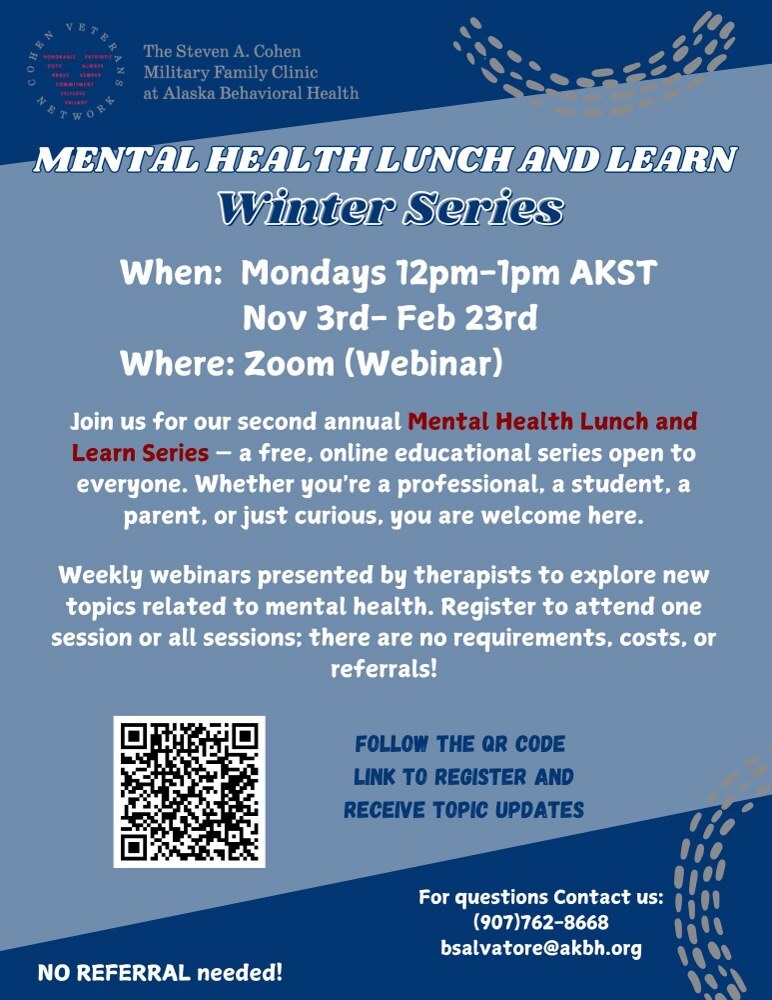
Looking to deepen your understanding of mental health and ways to offer support? The Mental Health Lunch & Learn: Winter Series offers free, therapist-led sessions every Monday. Join ABH for practical insights and open conversation—no referral needed, just a welcoming space to learn and grow. Register here!
Alaska Training Cooperative Updates
December Senior Voice is Live
Visit seniorvoicealaska.com to read this month's articles or pick up a paper at a community center or library near you! Read about upcoming ACA premiums, Social Security spousal benefits, Alaska's healthcare workforce and much more.
Troy Medical Care: Medicare Patient Openings in Fairbanks
Troy Medical Care is now accepting new Medicare patients for primary care in Fairbanks. They also have an in-person provider for primary care to complement their hybrid-telehealth options.
All of their primary care patients are offered a local in-person dedicated medical assistant to help them with their care.
TMC also provides the following: Neurology, Rheumatology, Endocrinology, and Dermatology. Specialty patients are also offered an in-person dedicated medical assistant.
Call them at (907) 268-2737 or visit: www.troymed-fairbanks.com
Alaska Public Health Association Summit in Anchorage / Hybrid Jan 20-22
Alaska Public Health Association (ALPHA) Health Summit 2026 theme is "Stronger Together: Strengthening Public Health Through Partnerships," emphasizing ALPHA's commitment to ensuring equitable healthcare access and outcomes across our beautifully diverse state.
This year's conference will be held in person in the beautiful city of Anchorage, Alaska, with a hybrid option available for those who wish to participate online. To be a sponsor, an exhibitor, or to review the agenda, click here.
Parkinson's Foundation Community Grants Due Jan 30
The Foundation funds programs that are impactful, sustainable, scalable and measurable. Programs may be new and existing grant-supported areas and/or pilot programs. All funded organizations and institutions must demonstrate a commitment to diversity, equity and inclusion.
Programs for the 2026 grant cycle should be geared towards expanding or creating access for populations of focus and must incorporate at least one of the following focus areas:
- Address mental health and PD
- Reach and support care partners of individuals with PD
- Educate and deliver exercise programs specifically designed for people with PD
Submit your application by January 30.
AARP National Long-Term Care Ombudsmen Program Report
The Long-Term Care Ombudsmen Program (LTCOP) is the sole federal program dedicated to receiving and addressing the complaints of over two million Americans relying on nursing homes and assisted living facilities for essential services.
AARP recently released a report exploring trends in complaints, volunteer capacity, supports provided, and more for LTCOP. Key takeaways include:
- Volunteerism drives the LTCOP yet reported volunteer hours declined by more than half since 2016, from more than 600,000 hours to less than 300,000 hours in 2024.
- Loss of LTCOP volunteer capacity coincides with increasing need for their support. There were more complaints in 2024 than 2016 and specifically more complaints related to resident care.
- Individual ombudsmen face increasing pressures and on average are responsible for more beds per capita, increasing from 350 beds in 2016 to 603 in 2024.
- The LTCOP provides an important support for family caregivers and other family members of long-term care recipients, who make about one in four complaints ombudsmen receive each year.
Rural Health Information Hub Grant Announcements
3RNET Recruitment and Retention Assistance
Helps health professionals find jobs in rural areas and assists employers in recruiting and retaining health professionals in rural areas.
Geographic coverage: Nationwide and U.S. Territories
Applications accepted on an ongoing basis
Sponsor: 3RNET
CareQuest Philanthropy: Grants in Oral Health
Funding for projects that promote access to the oral health system. Priority populations include rural communities, people with disabilities, and older adults, among others.
Geographic coverage: Nationwide
Applications accepted on an ongoing basis
Sponsor: CareQuest Institute for Oral Health
Community Heart & Soul Planning, Technical Assistance, and Seed Grant Program
Community Heart & Soul is a community development process that engages residents in identifying what matters most to the community and how to build lasting change. Activities and objectives are determined by communities, and projects have included volunteerism, healthcare access, social programs, transportation, broadband, and emergency preparedness, among others. Seed grants are offered to qualifying small cities and towns interested in implementing the Heart & Soul model.
Geographic coverage: Nationwide and U.S. Territories
Applications accepted on an ongoing basis
Sponsor: Community Heart & Soul
Direct Relief Partnership Network
A partnership program for healthcare facilities that extends medication access to patients who are unable to afford prescriptions, reduces procurement costs of medications and supplies, and leverages resources to foster healthier communities. Partner facilities order online from Direct Relief's pharmaceutical inventory.
Geographic coverage: Nationwide
Applications accepted on an ongoing basis
Sponsor: Direct Relief
Firehouse Subs First Responder Grants
Grants for life-saving equipment, prevention education, and disaster relief for first responders and public safety organizations. The Foundation recognizes the needs of rural and volunteer departments throughout the country and will consider their applications despite not being within 60 miles of a Firehouse Subs restaurant.
Geographic coverage: Nationwide
Applications accepted on an ongoing basis
Sponsor: Firehouse Subs Public Safety Foundation
Hearst Foundations Health Grants
Program, capital, and endowment support grants for organization working to address access to healthcare for high-need populations, healthcare professional shortages, evolving healthcare demands, and medical research. Rural populations are a priority.
Geographic coverage: Nationwide
Applications accepted on an ongoing basis
Sponsor: The Hearst Foundations
ADvancing States Free IQ Online Learning Center
ADvancing States is encouraging Aging and Disability professionals to incorporate the ADvancing States IQ online learning center into their 2026 training plans. IQ provides no-cost courses and webinars focused on knowledge and skills for working with older adults, people with disabilities, and caregivers, with many trainings tailored specifically to Information & Referral or Assistance staff. Topic areas include consumer access, community integration, abuse prevention, Medicaid/Medicare, and quality. Recent additions cover kinship and grandfamilies, trauma-informed resource navigation, managing challenging interactions, serving veterans and caregivers, elder abuse and APS basics, Medicare cost-reduction tools, and dementia-related needs. New users must create a my.ADvancingStates account to access the training library, and support is available via email: support@advancingstates.org.
E4 Center: Resources for the Holidays
Below you can find webinars that may be helpful for both clinician and aging network professionals in navigating the unique challenges that the holiday season may bring.
For additional resources and information, please see the E4 Center's website.
Justice in Aging Updates
Last week, the Senate Special Committee on Aging held a hearing on the vital role of community living for older adults and people with disabilities.
Witnesses highlighted how Medicaid Home-and Community-Based Services (HCBS), Centers for Independent Living (CILs), affordable and accessible housing, and family caregivers enable individuals to remain in their homes, pursue education or employment, and stay connected to family and friends.
CDC Released 2023 PLACES Data
The Centers for Disease Control and Prevention’s National Center for Chronic Disease Prevention and Health Promotion is excited to announce the release of 2023 PLACES data.
How PLACES Can Improve Your Health Efforts:
- The PLACES data tool provides local, model-based estimates for understanding health outcomes, preventive service use, health-risk behaviors, disabilities, health status, and health-related social needs at the local level.
- PLACES covers various geographic areas, including counties, census-designated places, census tracts, and ZIP Code Tabulation Areas.
Unique Value of PLACES:
- PLACES enhances existing surveillance data by offering estimates for health issues in local areas of all sizes, whether urban or rural.
- The tool helps to inform targeted public health interventions and resource allocation to improve community health.
Overview of Release:
The latest PLACES model-based estimates are generated using 2023 data from the Behavioral Risk Factor Surveillance System (BRFSS), U.S. Census 2020 Population Count, and the American Community Survey 2019–2023 including:
- 35 measures from 2023 BRFSS data.
- 5 measures from 2022 BRFSS estimates: colorectal cancer screening, mammography, short sleep duration, dental visit, and all-teeth lost.
- The mental health measure “loneliness” has replaced “social isolation” for 39 states and the District of Columbia. Compared with social isolation, loneliness is a stronger indicator of health. It reflects a person's real feelings and experiences, and with the right support, people with loneliness can find help.
Data Tools:
Access a suite of PLACES interactive data tools to visualize, map, and compare local health data: PLACES Online Data Tools | PLACES | CDC .
You can access previously released data or access the entire PLACES Data Portal to search, select, view, query, and download PLACES data from current and past releases.
Learn more about the BRFSS or send an inquiry to CDCINFO@cdc.gov
NCOA Applauds Bipartisan Push to Boost Enrollment in Low-Income Medicare Programs
Medicare helps millions of older Americans stay healthy, but it isn’t free. The Medicare Improvements for Patients and Providers Act (MIPPA) helps make Medicare affordable by providing funding to find and enroll low-income people into money-saving programs. New legislation would reauthorize MIPPA for five years. Read the NCOA statement.
MAHA ELEVATE Brings Lifestyle Medicine to Original Medicare
CMS announced the Make America Healthy Again: Enhancing Lifestyle and Evaluating Value-based Approaches Through Evidence (MAHA ELEVATE) Model, a voluntary model to fund up to 30 chronic disease prevention and health promotion pilot projects that utilize evidence-based functional or lifestyle medicine interventions currently not covered by Original Medicare.
These types of interventions, including those focused on nutrition and physical activity, may slow or prevent chronic disease; MAHA ELEVATE will gather and evaluate necessary data on cost and quality to inform decisions about the feasibility of including such lifestyle-based interventions in Original Medicare in the future.
CMS will release a Notice of Funding Opportunity (NOFO) in early 2026 for the first cohort. The model will begin on September 1, 2026. The second cohort will begin 1 year later.
By building evidence for interventions that empower people with Original Medicare to improve their health upstream of costly treatments or procedures, MAHA ELEVATE will help transform the U.S. health care system to one that proactively addresses the root causes of chronic disease rather than reactively addressing symptoms.
CMS will test evidence-based functional or lifestyle medicine interventions currently not covered by Medicare through cooperative agreements with organizations that have already demonstrated success integrating these approaches into conventional medical care with scientifically documented improvements in health. Participating organizations will receive approximately $3 million each over 3 years of funding to collect quality and cost data on their interventions.
Interventions tested in the model are intended to support, not replace, the medical care received by people with Medicare. They may combine psychological, nutritional, and physical interventions along with self-care strategies to promote wellness and prevent illness.
Find out more:
Second Wind Dreams Zoom Educational Webinars
Empathy & Validation in the Face of Cognitive Change
The Dementia Education Series is a monthly 1-hour webinar offered on the 2nd Tuesday at 1pm Eastern, featuring Second Wind Dreams and guest speakers on dementia and related topics.
The 2026 series includes: January 13 - Navigating Dementia: Empathy & Validation in the Face of Cognitive Change, with Rita Altman.
Wisconsin Alzheimer's Disease Research Updates
The Wisconsin Alzheimer’s Disease Research Center’s December newsletter highlights upcoming educational and support events, and shares holiday coping resources for people with dementia and caregivers. Recent research updates include findings on how COVID-19 may influence Alzheimer’s-related protein buildup, and news about a validated Alzheimer’s blood test supported by WRAP study data. The newsletter also previews ongoing and future programs, like the Goals for a Cure campaign and much more.
U.S. Census Bureau: U.S. Workforce is Aging, Especially in Some Firms
Workers ages 55 or older have been the fastest-growing age group in the labor force for more than two decades and made up 24% of the U.S. workforce in 2022, up from 10% in 1994.
But not every workplace reflects this aging workforce.
New U.S. Census Bureau research shows that firms in some industries and some states had a much greater concentration of older workers than others.
In the Utilities sector, for example, the share of employment at firms with at least a quarter of their workers over age 55 rose from 35% in 2006 to 80% in 2022. In contrast, only about 10% of total employment in the Accommodations and Food Services sector was at firms with at least a quarter of workers over age 55.
Continue reading to learn more about:
- The distribution of older workers across firms over time
- The aging of firm workforces by state
Alaska News
Disclaimer: The information and announcements included in this email are being redistributed for informational purposes only. Our agency does not necessarily endorse or support the views, opinions, or activities of these organizations, and inclusion in this email does not imply any affiliation or recommendation.