
COVID-19 Alaska Clinical Update, Nov. 1
Alaska Department of Health sent this bulletin at 11/01/2020 07:46 AM AKST
Sunday, November 1
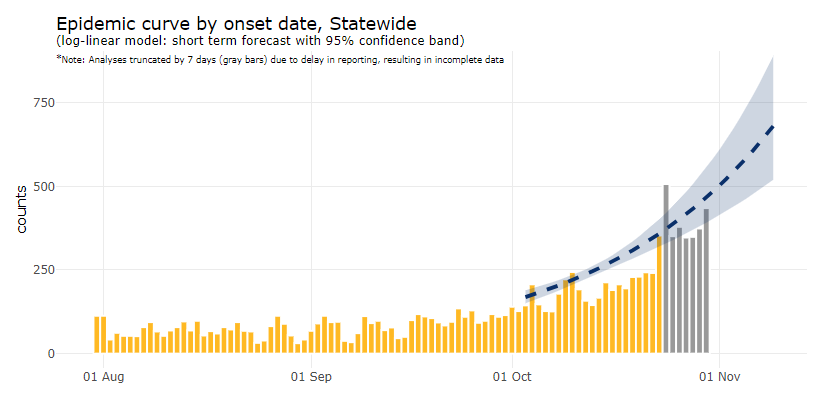
Alaska case update
15,274 Alaskans have been diagnosed with COVID-19. 441 have required hospitalization and 82 have died. Case rates continue to accelerate in Alaska overall with the highest case rates in these regions: Yukon-Kuskokwim, the Anchorage Municipality, the Kenai Peninsula and Matanuska-Susitna. 9 million Americans have been diagnosed with COVID-19 so far and more than 229,000 deaths are now reported. 46 million COVID-19 cases have been diagnosed worldwide. Total known deaths are nearly 1.2 million.
New handout available for patients getting tested - Contact tracing is a team sport and we need your help!
Please hand out this two-page handout to all patients getting tested for COVID-19. On the back of the flyer are directions for patients to start their own contact tracing, even before they get a call from a Public Health contact tracer which may take several days. The sooner those who test positive can isolate and close contacts can quarantine, the better we can control the spread of COVID-19. This handout has been updated with the recent CDC clarification that close contact is defined as being within six feet for 15 minutes, cumulative over 24 hours, and that the 15 minutes does not need to be continuous. The flyer is free to use and provides answers to many common questions as well as clear directions for what to do after being tested.
Aspergillus complicating COVID-19 pneumonia
A case series reports secondary aspergillosis in 20 patients in Spain and the US with severe COVID-19, adding to other case reports and case series describing similar superinfections. Cases were mainly diagnosed by bronchoalveolar lavage, a median of 11 days after symptom onset and 9 days after ICU admission, in patients requiring respiratory support. Notably, in this case series, although nodular necrosis and progressive consolidation was seen in some patients who had chest CTs in addition to typical COVID-19 pneumonia findings of ground glass opacities, crazy-paving, bronchiectasis, and airway wall thickenings, no CT reports highlighted the halo ground glass attenuation classically associated with angioinvasive disease. The author notes that the predominant pathophysiology of pulmonary aspergillosis seems to differ from invasive aspergillosis in immunosuppressed patients, with less angioinvasion but significant bronchial inflammation and invasion. The lack of angioinvasion may limit serum-based diagnostics.
Relatively prevalent as a complicating fungal infection in influenza, with one large study finding a 19% prevalence among adults admitted to ICUs with influenza (including 14% of those without known immunocompromise), aspergillosis is associated with high mortality in those cases, so there is reason to be concerned that secondary aspergillosis could increase mortality in severe COVID-19. Clinicians may want to consider aspergillosis in patients with severe COVID-19.
Vertical transmission risk may be low
A cohort analysis in JAMA Pediatrics followed 101 term infants born to mothers with perinatal SARS-CoV-2 at a hospital in NYC. Two infants tested positive for SARS-CoV-2 but none had clinical evidence of COVID-19 despite most infants rooming in and direct breastfeeding. The 55 infants seen in follow-up remained healthy. 19 infants were admitted to the NICU for non-COVID-19 related causes, and 6 other infants did not room in because mothers were admitted to the ICU. The NICU did not allow SARS-CoV-2 positive mothers to visit. Although this is just one study with only 101 neonates, these data do not suggest a need for mother-newborn separation, preventing breastfeeding, or early bathing of newborns.
In brief
Race, ethnicity and age trends reported in an MMWR found that Black and Hispanic Americans are disproportionately represented in COVID-19 fatalities, and the difference was more pronounced in August than it was in May 2020. CDC notes that this may be because of greater occupational exposure through people-facing jobs and disparities among access to healthcare.
A CDC MMWR noted a pattern where hotspots of high transmission generally started with early increases in test positivity rate in children, teens and young adults an average of 31 days before hotspot identification. Later, after those increases, positivity rates increased in older groups: adults aged 25-44 began around 28 days prior to detection, age 45-64 around 23 days prior and age 65+ around 20 days prior. At the time hotspots were detected, percent positivity was generally highest in people aged 18-24 and peaked before peaks in older groups, illustrating that viral transmission often increases in younger age groups first, older age groups second and then hospitalizations and deaths go up later as the oldest age groups are impacted.
A hockey-associated outbreak in June was traced to a single player who played a game while asymptomatic and then developed symptoms the next day. 8 of 10 players on the infected player’s team, who had no known contact with other exposures outside of this hockey game, tested positive during the investigation after the game. Interestingly, 5 players from the opposite team, who did not share a locker room, a bench or otherwise have known contact with other exposures, also tested positive, as did a rink employee. CDC hypothesizes that vigorous exertion and deep breathing during the indoor game may have contributed. No players wore masks.
Opioid CME reminder
AK legislation requires two hours of CME in pain management, opioid use and addiction. For more information and suggested CME options, visit http://dhss.alaska.gov/dph/Director/Pages/opioids/education.aspx
|
STAY CONNECTED:


SUBSCRIBER SERVICES:
Manage Preferences | Unsubscribe | Help
Update your subscriptions, modify your password or email address, or stop subscriptions at any time on your Subscriber Preferences Page. You will need to use your email address to log in. If you have questions or problems with the subscription service, please contact subscriberhelp.govdelivery.com.
This service is provided to you at no charge by the Alaska Department of Health and Social Services.
For general COVID-19 questions, email covidquestions@alaska.gov.