| |
 |
|
Department of Veterans Affairs (VA) Engages Family Caregivers in Application Design
Nancy Wilck, Veterans Health Administration (VHA) Human Factors (HF) Office, Program Manager, Primary Managing Editor
VA recently funded a Mobile Health pilot project to give 1,000 VA Caregivers of seriously injured, post-9/11 Veterans an iPad with software applications (apps) that aim…
Read More
|
|
 |
| |
 |
Patient-facing Software: A Novel Approach to Capturing a Better Medication History
Dr. Blake J. Lesselroth, Portland VA Medical Center, Portland Informatics Center - Patient Safety Center of Inquiry (PIC-PSCI), Hospitalist/Informatician, Associate Director; Stephanie Tallett, Program Analyst; Matthew Isham, Program Analyst
Even though medical professionals strive to be faultless, discrepancies in medication documentation sometimes occur. An estimated 25-30 percent of these inconsistencies are significant and may result in disability or death. Often these errors occur during…
Read More
|
 |
 |
Speech-To-Text Technology in the Department of Veterans Affairs (VA)
Dr. J. Ben Davoren, San Francisco VA Medical Center, Associate Chief of Staff for Clinical Informatics
Speech-to-text recognition software is changing everyday healthcare practices and it is expected to become increasingly prevalent. The most mature implementation of speech-to-text software is in radiology report dictation…
Read More
|
|
 |
User Experience (UX): The Focus of Design for Veterans Health Administration (VHA)’s Next Generation Health Information Technology (HIT)
Ross Speir, Veterans Health Administration (VHA) Human Factors (HF) Office, Program Manager, Cognitive Engineer
The current wave of technology advancement promises extraordinary gains in the capabilities of HIT. These advancements can enable VHA's next-generation HIT to transform health care delivery to our nation's Veterans…
Read More
|
|
 |
Strategic Health Information Technology (IT) Advanced Research Project for Patient Centered Cognitive Support (SHARPC)
Dr. Jiajie Zhang, National Center for Cognitive Informatics and Decision Making in Healthcare (NCCD), Strategic Health IT Advanced Research Project for Patient-Centered Cognitive Support (SHARPC), Associate Dean for Research; Dr. Muhammad Walji, Associate Director; Dr. Amy Franklin, Assistant Professor
The National Center for Cognitive Informatics and Decision Making in Healthcare (NCCD), located at the University of Texas Health Science Center at Houston (UTHealth), is a nationwide collaboration…
Read More
|
|
| |
Upcoming Events
July 21–25, 2012
San Francisco, CA
2nd International Conference on Human Factors and Ergonomics in Healthcare
The international conference highlights new research to improve safety and effectiveness of patient healthcare. Learn More
September 21–24, 2012
San Francisco, CA
Mobile HCI '12
14th International Conference on Human Computer Interaction with Mobile Devices and Services. Learn More
The Human Factors (HF) Office within the Veterans Health Administration (VHA) seeks to increase awareness of human factors products and services among clinical end users and other stakeholder groups. This quarterly newsletter will serve to engage these communities in shared communication and collaboration around human factors-related issues.
|
|
|
| |
|
Department of Veterans Affairs (VA) Engages Family Caregivers in Application Design
Nancy Wilck, Veterans Health Administration (VHA) Human Factors (HF) Office, Program Manager, Primary Managing Editor
VA recently funded a Mobile Health pilot project to give 1,000 VA Caregivers of seriously injured, post-9/11 Veterans an iPad with software applications (apps) that aim to improve the lives of both VA Caregivers and the Veterans they care for. Many VA Caregivers suffer from greater emotional and financial stress than non-VA Caregivers due to the severity of Veterans' conditions. See the National Alliance for Caregiving's report Caregivers of Veterans - Serving on the Homefront for more information.
To ease these burdens, VA took an unprecedented approach to directly engage VA Caregivers in app design and usability assessments. The project resulted in the creation of high-fidelity models addressing a number of VA Caregiver needs, and its success has sparked an interest in using user-centered, or participatory, design for a number of other applications. This project was conducted in three distinct phases. First, the design team hosted a design session with the Caregivers, then engaged a different group of Caregivers in assessing the design's usability and, lastly, validated the designs based on user feedback.
User-Centered Approach
The participatory design sessions took place in five cities: Washington, D.C.; Baltimore, MD; Martinsburg, WV; Durham, NC; and Atlanta, GA. VA Caregivers in each location took part in two design sessions. VA staff worked directly with the Caregivers to understand their needs and to identify ways in which the apps could help Caregivers manage daily activities.
The first two rounds of design sessions analyzed an initial set of capabilities that were to be incorporated into the iPad applications. VA facilitators elicited input from Caregivers about day-to-day tasks, pain points and ways in which they would like to receive and provide information to VA. The Caregivers brainstormed a list of top needs that would help to track their Veterans' data:
- Access to portions of patient medical information from VA and non-VA health care records;
- Improved communication with the care team, including Secure Messaging (SM);
- Electronic appointment requests;
- Medication management and online refills; and
- Electronic journaling and image sharing.
Using a VA-owned visual modeling tool, the VA team created an initial set of app designs based on Caregiver input and continuously refined the models during each of the sessions.
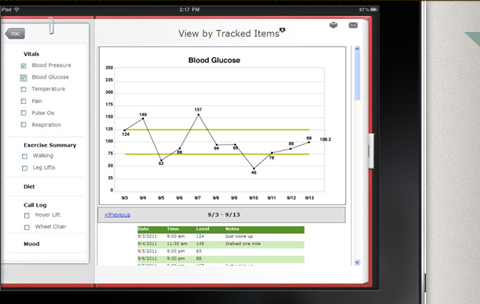
Afterward, a group of Caregivers who had not participated in the design sessions performed usability assessments using the visual models. Then, during the validation phase, Caregivers suggested final changes to improve design utility and usability, like adding the ability to reschedule medical appointments. The designs were refined according to Caregiver feedback, incorporating components like graphing vital signs or emailing information to a provider. The image above shows an example of the final journal tracking page.
As a result of this project, the VA team developed high-fidelity models which have provided the basis for five apps. The apps are in various stages of development and VA is recruiting Caregivers to participate in usability assessments for these new tools as well as to brainstorm additional products.
Learning from Caregivers
VA Caregivers were very enthusiastic about this project and appreciated VA's recognition of their important role. Many Caregivers remarked that the sessions themselves were like therapy, as they were able to share with others who understood their challenges.
Thanks to the direct input from the participants, we feel confident that these apps, which will be available at the end of Fiscal Year (FY) 2012, will be useful for Caregivers and Veterans. They will facilitate day-to-day care through medication(s) administration and appointment reminders. With the ability to securely email photos to Caregivers, the apps may potentially eliminate the time-consuming need for some in-person appointments. In addition, access to portions of the Veteran's health care record information will ease the burden of caretaking. Providers may also benefit from improved communication with Caregivers and appreciate having access to information, such as vital sign graphs, which can help care teams identify health trends.
In future issues of this newsletter, we will feature additional articles on the Mobile Health project and lessons learned as we engage Caregivers in application testing.
Back to Top
|
|
|
Patient-facing Software: A Novel Approach to Capturing a Better Medication History
Dr. Blake J. Lesselroth, Portland VA Medical Center, Portland Informatics Center - Patient Safety Center of Inquiry (PIC-PSCI), Hospitalist/Informatician, Associate Director; Stephanie Tallett, Program Analyst; Matthew Isham, Program Analyst
Even though medical professionals strive to be faultless, discrepancies in medication documentation sometimes occur. An estimated 25-30 percent of these inconsistencies are significant and may result in disability or death. Often these errors occur during changes in care, such as when altering therapeutic plans or switching health care providers. Health care quality organizations, including the Joint Commission and the Department of Veterans Affairs (VA) Office of Quality and Performance, have called for the establishment of standardized medication reconciliation (MR) practices. In response to this push to improve medication safety, VA has launched a number of initiatives to close information gaps and enhance the MR process.
The Portland Patient Safety Center of Inquiry (PSCI), sponsored by the VHA National Center for Patient Safety, seeks to develop, implement and evaluate technologies and processes supporting MR. In 2006, the Portland PSCI designed the Automated Patient History Intake Device (APHID). APHID is an ambulatory check-in kiosk equipped with touchscreens and locally developed, self-service software. The team used a combination of agile programming principles and user-centered design techniques throughout the development lifecycle. Initial requirements were designed by clinician end-users and early prototypes were piloted with Veterans. This approach enabled the team to identify important usability barriers, streamline the Veteran experience and improve the validity of patient-furnished data. Currently, patients can check-in for an appointment, review their allergies and complete a medication adherence questionnaire prior to a clinical interview. The kiosk's screen shows the patient's prescription paired with a medication photograph in order to help him or her identify and recall medications. With the kiosk's touchscreen technology, termed VetLink, Veterans can validate the accuracy of the prescription, indicate their use patterns using push-button controls and even enter additional comments using a free-text dialog. APHID software then inserts the medication list and patient responses into the Computerized Patient Record System (CPRS) notes. Since implementation, the team has gathered usability feedback from Veterans using this technology. Based on a patient usability survey, patients generally found the tool easy to use and the interface easy to navigate. Approximately two-thirds of Veterans surveyed thought the program improved their medication recall.
Impact on MR
The Portland PSCI has studied the impact of the kiosk on MR documentation and early research indicates that the technology has a greater likelihood of exposing discrepancies and dramatically improving clinic documentation practices. However, clinicians struggle to find time to review data and often grow frustrated with the lack of available resources. In a primary care technology implementation study, 43 percent of primary care providers did not believe they had the resources to address identified medication discrepancies and 39 percent did not believe work schedules accommodated routine use of the APHID output.
National Deployment
With these findings in mind, the Portland PSCI has partnered with the Veterans Health Administration (VHA) Chief Business Office (CBO) to improve the original APHID software and distribute MR products nationwide. In 2010, the CBO appointed the Point-of-Service Integrated Project Team to design and deploy standardized Veteran-facing kiosks. Portland PSCI continues to furnish software code, development specifications, use-case data and clinical expertise to ensure an improved second generation of MR software. The Medication Allergy Review Module will be able to retrieve Veteran prescriptions from any VA facility, match prescriptions with pharmacist-validated digital medication images, compile a patient adherence history, collect patient-volunteered information about any non-VA medication(s) and create a report available to staff through CPRS. The software will also support advanced business intelligence to drive staff implementation and improve quality. The provider-facing and patient-facing graphic user interface designs have been updated to incorporate patient feedback and staff focus group responses gathered throughout APHID piloting.
Future Applications
In addition to the national kiosk project, the Portland PSCI staff is focusing on adapting APHID technology for hospital admissions. The project will occur in two phases: (1) PSCI staff are collecting qualitative and quantitative data on current admission MR processes and (2) inpatient clinical pharmacists are piloting modified APHID software at the bedside using wireless tablet personal computers (PCs) to identify potential usability and technology issues. Drawing from the fields of anthropology, human factors engineering and cognitive science, the team is using mixed methods—including task analysis, think-aloud protocols, cycle-time collection and semi-structured interviews—to articulate the behaviors, needs and expectations of clinical staff. Already, the Portland PSCI has analyzed the cognitive steps that are necessary for MR but these steps are rarely discussed in reports and have yet to be addressed in technology installations. Ultimately, Portland PSCI should be able to institute a new patient-centered admission reconciliation program and publish research findings to inform future MR technology development.
To learn more about the Portland PSCI, visit the Portland PSCI webpage at http://moss.portland.med.va.gov/PSites/pcc/PIC/default.aspx or send an email to Human Factors at vha10p2hfq@va.gov.
Back to Top
|
|
|
Speech-To-Text Technology in the Department of Veterans Affairs (VA)
Dr. J. Ben Davoren, San Francisco VA Medical Center, Associate Chief of Staff for Clinical Informatics
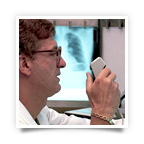
Speech-to-text recognition software is changing everyday health care practices and it is expected to become increasingly prevalent. The most mature implementation of speech-to-text software is in radiology report dictation, which has drastically reduced report turn-around times. Many studies, including Impact of Speech Recognition on Radiologist Productivity, have demonstrated both a voice recognition accuracy exceeding 98 percent as well as increased radiologist productivity. For example, by using a macro patterning program, simply saying "normal chest" generates a long paragraph detailing the conditions of a normal chest radiograph, which, in turn, expedites standard reporting procedures.
VA utilizes a variety of medical speech-to-text software products, which have revolutionized the day-to-day activities throughout many VA services. With more than 7,500 providers using these types of software, the Computerized Patient Record System (CPRS) is more accurate and accessible than ever. In addition, adopting a speech-to-text radiology report transcription has helped VA meet a performance measure to have more than 90 percent of radiology reports transcribed and authenticated within forty-eight hours of study performance. Due to VA's positive experience with these technologies, the VA intranet hosts software user groups, promotes the vast benefits of adopting speech-to-text technologies for CPRS and directs care teams to freely distributed CPRS-specific macros and commands.
The VA Human Factors Office reviewed a number of case studies in 2011 regarding speech-to-text technology in health care and subsequently conducted a user experience field evaluation of Dragon Medical. At the time, Dragon Medical was the only medical voice recognition software known to be in use in VA. Between this field evaluation and interviews with several VA users, the findings indicated the affordances and barriers to adopting speech-to-text technology. Within VA, specifically, the Human Factors Office's above referenced study of seven physicians in clinical scenarios revealed that:
- Speech-to-text technology appears to have a rather steep learning curve;
- Effective use, particularly of advanced features, is aided by continued training and support;
- Speech-to-text technology tends to be more effective and faster than typing, for longer, narrative-based notes than for shorter "snippets" of data imported into note templates. As such, many users combined speech-to-text with CPRS templates;
- The presence of a local "champion" staff member makes software adoption more likely; and
- Text generated by speech-to-text technology is similar in accuracy to that generated by keyboarding.
Barriers to more widespread adoption of speech-to-text technology fall into two main categories. First, licenses tend to be both user- and device-specific, meaning that the system and its related hardware are restricted to one or a few physical work stations rather than being available in multiple locations where providers may find themselves working. Enterprise solutions use server-based voice profiles, thereby eliminating the need to use a specific machine that houses a voice profile and, in turn, cuts millions of dollars in transcription costs. Secondly, multiple studies indicate the need for sufficient and sustained training in order for the technology to be adopted. Even though incorporating basic speech-to-text abilities tends to be a welcomed transition, ongoing training seems to be required in order for users to grasp more intricate functions and adopt the system fully.
Aside from use in dictating clinical records, voice recognition technologies have the potential to improve general VA workflow. For example, free dictation apps such as Dragon are available for use with email on some mobile devices. The speech-to-text shortcut can accelerate responses to long emails, especially when compared to the time required to type emails on small smart phone keyboards and some apps are specifically programmed to transcribe entire documents—as long as network connection is available. Some apps are particularly interesting because they do not learn the voice profile of the user over time, but neither do they require any sort of voice training, unlike most voice recognition software. As a result, they are user friendly, but do not have the sophisticated vocabularies required for accurate medical dictation. False translations, such as speaking "twelve new medications" and having it return "twelve pneumatic Haitians" can be a consequence.
To learn more about VA practices regarding speech-to-text solutions and to explore how you can benefit, visit the Speech-to-Text VA user survey on the VA Human Factors Office SharePoint site: http://vaww.infoshare.va.gov/sites/chio/EHT/projects/POC/Lists/SpeechtoText%20User%20Review/overview.aspx or send an email to Human Factors at vha10p2hfq@va.gov.
Back to Top
|
|
|
User Experience (UX): The Focus of Design for Veterans Health Administration (VHA)'s Next Generation Health Information Technology (HIT)
Ross Speir, Veterans Health Administration (VHA) Human Factors (HF) Office, Program Manager, Cognitive Engineer
The current wave of technology advancement promises extraordinary gains in the capabilities of HIT. These advancements can enable VHA's next-generation HIT to transform health care delivery to our nation's Veterans. No longer will software be designed for the single screen, keyboard and mouse. Next-generation HIT will work seamlessly across multiple devices. Software will no longer designed from the perspective of the single user. Next-generation HIT will facilitate multi-user interactions, such as collaboration among care team members and communication between patient and clinician. And no longer will software require inordinate mental focus from users to step through screens. Next-generation HIT will recognize usage context, anticipate user needs and support user reasoning so that users' mental energy will be focused on the clinical task, not on the HIT tool itself.
This vision for VHA's next-generation HIT is based not only on the opportunities afforded by technology advancements, but also on the assumption that user experience (UX) becomes front and center in technology adoption efforts. Indeed, the impact on user experience must be a measure for integrating new technologies into the environments, workflows and services that HIT is intended to support. Although this focus on the human experience — literally termed "targeting experience" — poses a formidable, but highly worthwhile, challenge for health care improvement professionals (Bate, Robert, and Maher, 2007), it is absolutely necessary in order to keep VHA on the cutting edge of health care delivery.
A user's experience with HIT is characterized by how that individual feels while using the system. Subjective in nature, UX is derived from very meaningful (and testable) aspects of the human-system interaction: how well users understand the system, the extent to which the system supports user objectives, the efficiency and effectiveness of users carrying out those objectives and how well the system fits into the usage context (Garfinkel, 1967). Assessing the experiences of users (e.g., Veterans, Caregivers, clinicians, etc.) with HIT can be carried out easily after software release. User surveys can measure attitudes and opinions about an HIT system — a good barometer of user experience. Observational studies, usability tests and system usage analytics will provide more precise insights to the causes of unfavorable experiences with HIT and will identify potential remedies for improvement.
Assessing the user experience prior to system deployment is more complicated, particularly with HIT systems that must integrate into complex clinical environments and workflows, but it can be done. Further upstream in the HIT design lifecycle (when simulating and measuring the holistic experience of users is often impractical), a variety of methods and tools are available to measure the specific components of a user's experience with HIT. Some examples of UX measures include ease of use, efficiency of use, ease of learning, alignment with user objectives, alignment with users' mental model, alignment with clinical workflow and "fit" in the usage context. Measures can be performed at various stages of the HIT design process (from storyboard to functional system) and with varying levels of measurement rigor (from a quick "sanity check" to statistical confidence).
UX methods and tools can enable VHA to put user experience at the heart of designing next-generation HIT. To learn more about UX and what the Human Factors Office is doing to facilitate next-generation HIT, look for the next issue of Human Factors Quarterly (early September 2012), or send an email to Human Factors at vha10p2hfq@va.gov.
Back to Top
|
|
|
Strategic Health Information Technology (IT) Advanced Research Project for Patient Centered Cognitive Support (SHARPC)
Dr. Jiajie Zhang, National Center for Cognitive Informatics and Decision Making in Healthcare (NCCD), Strategic Health IT Advanced Research Project for Patient-Centered Cognitive Support (SHARPC), Associate Dean for Research; Dr. Muhammad Walji, Associate Director; Dr. Amy Franklin, Assistant Professor
The National Center for Cognitive Informatics and Decision Making in Healthcare (NCCD), located at the University of Texas Health Science Center at Houston (UTHealth), is a nationwide collaboration established in response to the urgent and long-term cognitive challenges in adoption and meaningful use of Electronic Health Records (EHR). NCCD is a national resource that provides strategic leadership in EHR usability, workflow and cognitive support. As an awardee of the Office of the National Coordinator (ONC) for Health Information Technology's SHARPC, NCCD carries out interdisciplinary research that addresses the cognitive challenges identified by ONC. These challenges include: work-centered design, cognitive foundations for decision making, adaptive clinical decision support, model-based data summarization and visualization.
SHARPC is composed of five different projects addressing these issues. Project 1, focusing on work-centered design, incorporates human factors theories and methods with EHR assessment. The purpose of this portion of the overall SHARPC initiative is to develop short-term, quick-fix tools and long-term breakthroughs for EHR usability and workflow challenges. Project 1 is a joint effort across UTHealth, University of Washington and Baylor Health Care System. Through Project 1, we have developed four products: a Rapid Usability Assessment (RUA) Protocol to quickly identify and prioritize critical usability problems in health information technology (HIT), a comprehensive framework called TURF that defines, measures, and helps design EHR usability, a software tool for semi-automating EHR usability evaluation and design and a workflow modeling tool called MATH that describes, captures, models, measures and predicts workflow of EHR use from a work-centered perspective.
Project 1 at SHARPC makes use of an EHR usability lab for many aspects of the project work. The lab supports the systematic evaluation of the usability of commercial EHRs. Vendors who participate in SHARPC's usability assessments receive a comprehensive and confidential report highlighting the optimal time to perform EHR related tasks and a listing of usability challenges users might face as they attempt to use the system. These results can be used to identify areas in the EHR that may need improvement. SHARPC's usability assessments of commercial EHRs have shown the presence of major usability problems that could lead to data entry errors by users. These assessments have also indicated that routine tasks, such as entering and reviewing orders through computerized physician order entry (CPOE), take several minutes to complete, thus likely limiting valuable patient-to-practitioner communication time during an office visit. The SHARPC Project 1 team also contributed to the standardized protocol for assessing EHR usability, which was released by the National Institute of Standards and Technology (NIST) in February 2012 (NISTIR 7804)*. EHR developers can use this protocol immediately to ensure that their systems are safer to use and to reduce use errors.
Future work in Project 1 focuses on defining the impact of design issues on patient care and practitioner decision-making and developing exemplary interfaces that conform to best practices in interface design. SHARPC expects Project 1's methods and tools to have a large impact on improving clinicians' adoption and meaningful use of EHRs by addressing the urgent usability and workflow challenges in existing systems. The ultimate goal is to revolutionize EHR usability with model-based design and reduce safety risk from unpredictable user behavior while, at the same time, generating methods to optimize designs for safe, effective and efficient user interaction with EHRs.
The other four SHARPC projects focus on the following patient centered cognitive support-related areas:
- Cognitive support for clinical comprehension (Project 2a);
- Clinical Decision Support (CDS) adaptation to local settings (Project 2b);
- Automated clinical summarization (Project 3); and
- Cognitive information design and visualization (Project 4).
For more information please visit the SHARPC website http://www.uthouston.edu/nccd/projects/sharpc/index.htm or send an email to Human Factors at vha10p2hfq@va.gov.
*Editor's note: For more information about NIST and NISTIR 7804, see the article written by Matt Quinn of NIST in our March 2012 issue.
Back to Top
|
|
 |
|
|