|
Chinese delegates travel 7,000 miles to learn about Minnesota water quality efforts
 When 12 delegates from China recently arrived in Minneapolis, they knew they were in the right place when seeing a sign announcing, “Minnesota, Land of 10,000 Lakes.” Coming from Hubei Province, known as the “Province of 1,000 Lakes,” the delegates were here to discuss a Sister Lakes program for their Liangzi Lake and our Lake Pepin.
Initiated by the U.S. Environmental Protection Agency (EPA), the purpose of “Sister Lakes” would be to share information and ideas.
“We’re interested in working together to improve water quality in both of our countries,” said Rebecca Flood, assistant commissioner for the Minnesota Pollution Control Agency (MPCA).
Hubei Province, in eastern China, is striving to protect the water quality of Liangzi Lake, the second largest freshwater lake in the province. Located near the city of Wuhan, with a population of 9 million, this lake faces development pressure. The Chinese Ministry of Environmental Protection and the Hubei Dept. of Environmental Protection have taken several steps to protect the lake, including controls on wastewater and industrial pollutants, cultivation of desired aquatic plants, and fish stocking.
Minnesota is striving to restore the water quality of Lake Pepin, a natural impoundment of the Mississippi River between Red Wing and Wabasha. State and local agencies on both the Minnesota and Wisconsin sides of the lake are working to reduce sediment that clouds the water in the Mississippi and that is filling in Lake Pepin. Clearing up the water will help grow desired aquatic plants for fish and wildlife, as well as enhance recreation.
While different in size and geography, the two lakes face similar water quality challenges, including better control of stormwater runoff. Read the full story on the MPCA website.
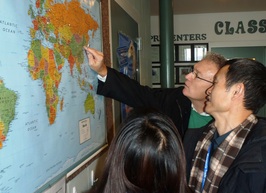
In the photo above, Mike McKay of the Lake Pepin Legacy Alliance learns the location of Liangzi Lake from Zhou Xinxin of the Hubei Province Dept. of Environmental Protection. Chinese delegates traveled 7,000 miles from Hubei to Minnesota to learn about water quality efforts here. Their trip included meetings in Washington D.C. before coming to the Twin Cities.
|
The MPCA is accepting proposals for Clean Water Partnership grant and loan funding through March 8. Proposals will be accepted from local governmental units interested in leading a nonpoint source pollution control project to protect or improve water bodies.
Priority for funding will be given to projects preventing degradation of unimpaired waters. For a project to be considered a protection/prevention project, proposers will need to document that the water body(ies) being addressed is currently meeting state water quality standards for a particular pollutant of concern, or has not been assessed but is known to be supporting beneficial uses.
The MPCA anticipates allocating about $1.1 million for grants and about $5 million for loans this year.
For more information, visit the Clean Water Partnership webpage on MPCA website.
The MPCA recently awarded more than $900,000 to local partners to conduct water monitoring work to gather long-term information at smaller scale streams and rivers in southern Minnesota. Water samples will be collected during snowmelt and rain events, when watershed runoff is high, and during base flow conditions – the typical flow in rivers when rain or snowmelt is not occurring.
The MPCA will combine these water quality data with stream flow information to estimate overall contaminant loading from a watershed.
This effort is part of agency-led Watershed Pollutant Load Monitoring Network, which collects data to provide information about the health of Minnesota watersheds – our rivers and what feeds into them. The information helps identify where excessive pollutants are entering river systems, from both point and nonpoint sources. Because this network is statewide and long-term, it can be used to identify trends over time and compare one part of the state to another. It is also useful for evaluating the effectiveness of remedial activities and to monitor for protection. For more information, please visit the network’s website.
For the recent funding round, the MPCA has awarded grants to:
- Cannon River Watershed Partnership;
- Chippewa River Watershed Project;
- Fillmore Soil and Water Conservation District;
- Hawk Creek Watershed Project;
- Minnesota State University-Mankato Water Resources Center;
- Redwood Cottonwood Rivers Control Area; and
- Zumbro Watershed Partnership.
These grants are funded by the Clean Water, Land and Legacy Amendment.
The Minnesota Board of Water and Soil Resources (BWSR) voted Dec. 12 to approve $18 million in Clean Water Fund grants to local partners throughout the state to protect and restore lakes, streams and groundwater. Several projects are located in the Greater Blue Earth River, Minnesota River and South Metro Mississippi watersheds. See a map of funded projects on the BWSR website.
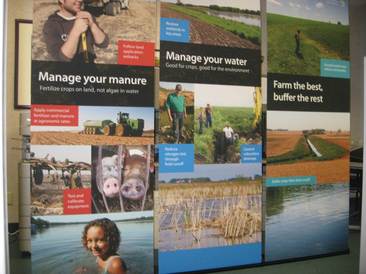
Minnesota may be the sixth largest contributor of nitrogen to the Gulf of Mexico, according to MPCA research. Reducing that nitrogen load through agricultural Best Management Practices will be one focus of the MPCA booth at the annual Minnesota Ag Expo in Mankato the week of Jan. 28.
The Ag Expo, an annual gathering of Minnesota corn and soybean growers, offers an ideal opportunity to talk about the statewide plan that Minnesota is beginning to develop this year to reduce nutrients in water resources.
Hypoxia in the Gulf of Mexico is driving the nutrient-reduction plans for Minnesota and other states. However, Minnesota is also concerned about the impact of excessive nutrients to other downstream waters such as Lake Winnipeg in Canada as well as waters within the state.
While beneficial to crops, excess nutrients can be harmful to water resources, making drinking water unsafe for human consumption, fueling algal blooms in rivers and lakes, and using up oxygen in water, leading to fish kills.
While several state agencies and local partners are working to reduce excessive levels of nutrients in water resources, there is more to do. For example, agencies and partners can be more efficient in their work by targeting key areas and nutrient sources. Part of the MPCA study includes identifying the watersheds with the heaviest loads of nutrients in runoff. Also, the state has seen success in lowering phosphorus in some rivers, but rising nitrogen levels are a concern.
Minnesota’s plan will address both point and nonpoint sources. A group of state agencies plans to take input from stakeholders throughout the state and complete the plan by the end of 2013. Iowa currently has its plan on public notice.
Learn more about the Minnesota effort on the MPCA website and in a recent Agri-News story.
|
The Minnesota River Board will discuss its future at its next meeting, scheduled for Feb. 11 at the Sibley County Service Center in Gaylord. After losing state funding, the board has been studying the options for its continued operations or for establishing a different basin-level entity. An external review team is collecting data and seeking input from stakeholders in order to compile a set of recommendations on the board’s future and basin organization. Members will discuss the findings of the basin review team and the next steps for the board at the Feb. 11 meeting. Please RSVP by Feb. 4 to susan.carlin@mnsu.edu if attending for sure.
- Feb. 9: Clean Up the River Environment annual meeting, Prairie's Edge Casino Resort, Granite Falls.
-
Feb. 13: Hawk Creek annual meeting, MinnWest Technology Campus, Willmar.
- Feb. 15: Ag BMP Handbook for Minnesota,Mississippi River Forum, McKnight Foundation, Minneapolis, 8-9:30 a.m.. RSVP to Lark Weller of the National Park Service.
-
March 21: Chippewa River Watershed Project annual meeting, 5 p.m., Starbuck community center.
Several staff members from the MPCA continue to develop responses to comments received on the draft TMDL reports for the Greater Blue Earth River (turbidity), Minnesota River (turbidity) and South Metro Mississippi (total suspended solids).
The agency has posted the comments received during the public notice periods for the Greater Blue Earth River and Minnesota River, and expects to post comments on the South Metro Mississippi TMDL in early February.
|




