|
 |
Climate newsletter |
|
|
Issue 119 | 12 August 2026 |
|
"Another record-breaking summer now looks increasingly likely for the UK, following the second-warmest June, and second-warmest July on record and yet another heatwave imminent,” said Met Office Senior Scientist Mike Kendon in a blog yesterday.
“We’ve seen temperatures hit 38°C in June, 35°C in early and late July, and this threshold is looking to be reached again in the next few days. It’s worth remembering we also reached 35°C in late May and easily exceeded both the May and June previous all-time temperature records this year. These statistics are a clear reminder – if one were needed – of the stark changes that we are seeing in the UK’s climate.”
The BAMS State of the Climate report, published earlier this week, shows that the global climate in 2025 set several new records, including atmospheric concentration of carbon dioxide, the loss of glacial ice from mountain regions, and the dryness of global soils. The report demonstrates that many climate metrics are deteriorating in line with the ongoing increasing concentration of greenhouse gases in the atmosphere.
The State of the Climate report is published by the American Meteorological Society with over 600 scientists from 60 different nations contributing to this latest edition. The Global Climate chapter covers over 40 different metrics, with the editorial team led by the Met Office.
|
|
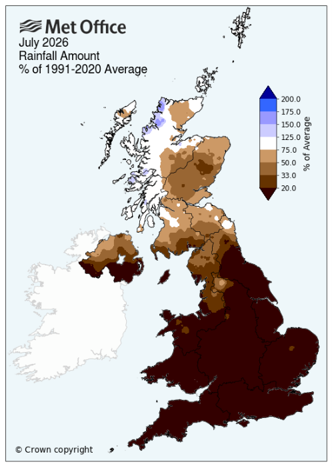
England and Wales have provisionally recorded their driest July on record, with Southern England seeing its driest month ever recorded, in a series dating back to 1836.
Met Office Science Manager Dr. Amy Doherty said: "July 2026 has been a truly remarkable month in the UK's climate record. Both England and Wales have provisionally recorded their driest July on record – Wales also its joint warmest. Southern England has seen its driest month ever recorded, and England and Wales have each experienced their sunniest month ever observed.
“The combination of record-breaking dryness, exceptional warmth and unprecedented sunshine has delivered one of the most notable summer months in our historical records."
|
|
|
Climate change was not the cause of the lack of rain in April-June this year, according to analysis by the World Weather Attribution (WWA) group of climate scientists. Rather, climate change's role in the ongoing drought is that it has directly contributed to the extreme heat, which is accelerating how much water evaporates out of soils. "Extreme heat is taking over as the primary driver of drought on our continent," said Sarah Kew, a climate scientist at the Royal Netherlands Meteorological Service.
|
|
With wildfires blazing across the UK, Europe and North America, there has been commentary across the media in recent weeks, including around the role climate change is playing in exacerbating the situation. Here’s a round-up of some of the recent news and commentary around wildfires.
The extreme heat and drought stoking huge wildfires in Spain and France were made far more likely by the climate crisis, a scientific analysis has found.
Wildfires in the UK and Europe are a "stark reminder of the challenges posed by an increasingly extreme climate", the Prince of Wales has said.
Wildfires are scorching the UK – people & nature have to be better protected.
What do wildfires mean for climate change?
Fighting fire with nature: How healthy landscapes reduce wildfire risk
|
|
Dis-, mis- and mal-information can often be quite compelling, cleverly using pseudo-science to get a point across, or sharing false or misleading information which appeals to genuine concerns or questions people might have. Unfortunately, misinformation around climate change is not uncommon, as well as on other topics, but how is it possible to tell whether something you see or hear is factual or not?
Disinformation is the deliberate creation and/or sharing of false information with the intention to deceive and mislead audiences. The inadvertent sharing of false information is referred to as misinformation. Malinformation deliberately misleads by twisting the meaning of truthful information.
|
|
|
Our Climate Conversations series covers the latest research and real-world impacts of climate change. Topics have included record-breaking marine heatwaves, the future of UK sporting events and sustainable education. Stay tuned, as there are more episodes coming up. You can watch all previous episodes on our playlist and subscribe to our YouTube channel or Spotify to keep up to date.
|
|
|
Follow us on our social media channels to join the conversation. Look out for our hashtag - #GetClimateReady - on X (formerly Twitter), and follow our climate channels on TikTok and Instagram.
You might also be interested in our new Government and Industry Newsletters. Subscribe here.
|
|
|
To subscribe or unsubscribe please visit our email updates page to access your preferences.
The Met Office is not responsible for the content of external internet sites.
|
|
|
|