|
 |
Climate newsletter |
|
|
Surface waters in Northwest European seas are currently experiencing moderate to severe marine heatwave conditions, with widespread areas of ‘strong’ (Category 2) conditions and some locations reaching ‘severe’ (Category 3).
This means that waters have reached temperatures usually expected in August and are on average 2 °C warmer than usual, locally reaching +4-5 °C anomalies offshore parts of the Welsh and English coasts.
Holly Clements, Met Office Head of Warnings and Guidance, said: “It is vital for the public to understand that although sea-surface temperatures are currently well above average in many coastal locations, this does not avoid the risk of cold-water shock. With warmer weather approaching, and even with marine heatwave conditions, it’s important to remember that the water around the UK is still cold. Entering it unexpectedly can lead to cold-water shock.”
|
|
Yesterday, the World Meteorological Organization (WMO) published the State of the Climate South-West Pacific 2025 report. According to the publication, 2025 was the 2nd warmest year on record for the South-West Pacific region with marine heatwaves disrupting ecosystems and fisheries and rising sea levels threatening vulnerable coastal communities and low-lying island nations.
“Across Asia and the Pacific, heat is intensifying multi-hazard risks, intersecting with food systems, public health, infrastructure and oceans, and placing new pressures on health and livelihoods. Early warning and early action save lives when alerts are timely, messages are trusted and last-mile delivery reaches the vulnerable,” said Armida Salsiah Alisjahbana, Executive Secretary of the United Nations Economic and Social Commission for Asia and the Pacific (ESCAP).
|
|
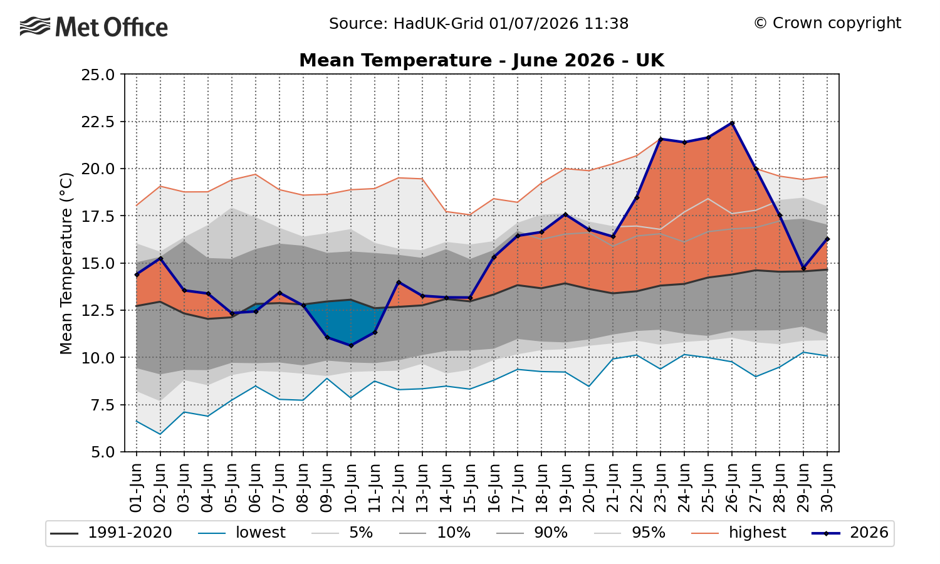
Provisional Met Office statistics, released on 01 July, indicated that June 2026 was England’s warmest June on record for average mean temperature, while the UK and Wales recorded their second warmest June in a series dating back to 1884.
It was a month of two halves ending in an exceptional late June heatwave. Professor Stephen Belcher CBE, Met Office Chief Scientist, said: “June’s heatwave was a significant weather event, with a Red Extreme Heat Warning issued. Human-induced climate change has made events like this more likely and more intense.”
|
|
From climate finance and adaptation to climate services and communications, this year’s London Climate Action Week (LCAW) highlighted a clear shift: the conversation is increasingly focused on resilience, real-world impacts and how climate intelligence can support better decisions today.
In our blog post, our experts share their reflections on the events they were involved in.
|
|
|
Adapting and building resilience to extreme heat is becoming increasingly important in our warming climate. As part of the Horizon Europe ASPECT project, Met Office scientists have been working closely with the British Red Cross to develop a new prototype website tool to help better understand their climate-related risk and help them to make informed decisions for adaptation and enhanced resilience.
|
|
|
Providing you with evidence-based information on climate science.
Have you ever wondered how the climate has changed in the past compared to how it is changing now? Natural changes do indeed occur in the earth’s climate, but global temperature rise over the last 100 years is happening at a rate 10 times faster than the average rate of warming after an ice age, surpassing any point during the last 2,000 years. You can dig a little deeper into this topic in the article and video below.
|
|
You are invited to join our kick-off webinar tomorrow for UK Climate Information (UKCI) - a new national climate service being introduced to support adaptation decision-making across the UK.
Based on robust science, UKCI is being developed to provide trusted, relevant and useable climate information for a wide range of users, including business, policy and decision makers.
At the webinar on Thursday 9 July from 1.30-3pm, you will be able to hear how we’re developing UKCI, learn about the evolving climate science underpinning the service, and find out how you can engage with the programme.
In case you aren't able to attend, the webinar will be recorded and we'll share a link to watch it back afterwards.
|
|
Our Climate Conversations series covers the latest research and real-world impacts of climate change. Topics have included record-breaking marine heatwaves, the future of UK sporting events and sustainable education. Stay tuned, as there are more episodes coming up. You can watch all previous episodes on our playlist and subscribe to our YouTube channel or Spotify to keep up to date.
The latest episode of Climate Conversations combines what we know about the 1976 summer with our knowledge of our changing climate. This includes the look ahead to 2056 shared above. Our presenter Alex Burkill speaks to Met Office Science Manager Dr James Pope and Newcastle University’s Professor Hayley Fowler.
|
|
|
Follow us on our social media channels to join the conversation. Look out for our hashtag - #GetClimateReady - on X (formerly Twitter), and follow our climate channels on TikTok and Instagram.
You might also be interested in our new Government and Industry Newsletters. Subscribe here.
|
|
|
To subscribe or unsubscribe please visit our email updates page to access your preferences.
The Met Office is not responsible for the content of external internet sites.
|
|
|
|