|
 |
Climate newsletter |
|
|
Issue 105 | 14 January 2026 |
|
Since the start of the new year, ourselves and other global climate centres have been analysing observations for 2025. These climate records are invaluable for determining trends. |
|
|
2025 has been confirmed as the third warmest year for global average temperature record in the HadCRUT5 dataset stretching back to 1850. The temperature for 2025 was 1.41±0.09°C above the 1850-1900 global average and follows 2024 and 2023 – currently the first and second warmest years in the series.
|
|
|
As well as producing global figures, we have also published detailed information on UK weather in 2025. The data highlighted that 2025 broke historical climate records, with provisional Met Office figures showing it has been both the warmest and sunniest year on record for the UK.
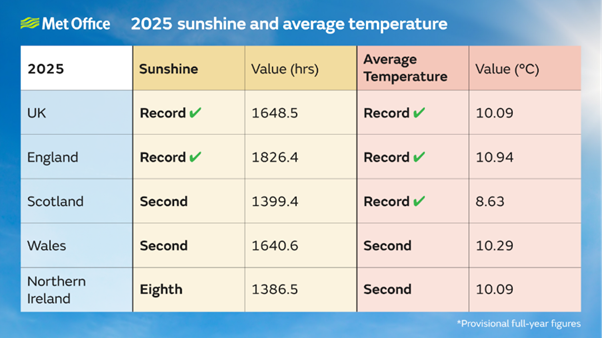
Met Office Scientist Dr Emily Carlisle said: “While many will remember the long warm spring and summer of 2025, what has been noteworthy this year has been the consistent heat throughout the year, with every month except January and September warmer than average.
“In the six months from March to August, every month was at least 1 °C above the 1991-2020 average. This resulted in the warmest spring and the warmest summer we have seen in this series.”
|
|
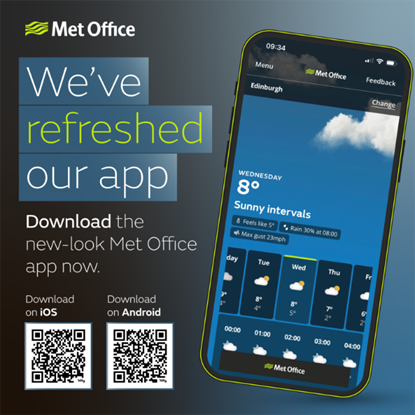
We are pleased to launch our new-look weather app this week.
The refreshed app has been designed to make our weather forecasts and warnings clearer and easier to use. With enhanced technology behind-the-scenes, now we can do more efficient improvements and have a unified design across iOS and Android to better meet our users’ needs.
Its features include new widgets, so you can see the latest forecast from your phone’s homescreen. You can also get instant notification of our severe weather warnings in your area and see all UK weather warnings from a single click.
We’ll continue to add more features over the coming months, including regional and long-range text forecasts.
If you already have our app, you’ll receive the refreshed app automatically or you’ll need to manually update, depending on your settings. It will also be available to download from the app stores for free.
|
|
Towards the end of 2025, we published our outlook for the global average temperature in 2026, which suggested an extension of the run of years with a value above 1.4 °C, compared to pre-industrial levels. The observational series of global average temperature records extends back to 1850.
Professor Adam Scaife leads the team behind the Met Office’s global forecast for 2026. He said: “The last three years are all likely to have exceeded 1.4 °C and we expect 2026 will be the fourth year in succession to do this. Prior to this surge, the previous global temperature had not exceeded 1.3 °C.”
|
|
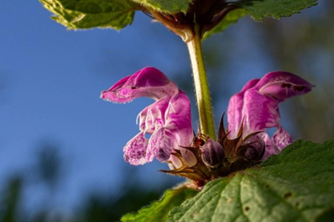
The New Year Plant Hunt, co-ordinated by the Botanical Society of Britain and Ireland (BSBI), is a survey recording plants in flower around New Year’s Day.
Commenting on the 2025 survey, Kevin Walker, Head of Science at BSBI, commented: “This new analysis shows a very clear link between rising temperatures and impacts on our plant species. This is yet further evidence that climate change is affecting our wildlife indiscriminately. This is a visible signal that everyone can see in their own gardens and communities.”
|
|
|
Earths’ climate is constantly changing and there are many natural drivers of this. Natural climate cycles, long-term shifts in the earth’s orbit and volcanic eruptions are examples of natural cycles and events which impact our climate, in some cases over thousands of years. But these can’t explain current warming which is occurring at over ten times the rate of warming after the last glacial period. Current warming is caused by increases in greenhouse gases in the atmosphere from human activities such as burning fossil fuels or changing how we use land.
|
|
Our next UK Climate Projections (UKCP18) webinar will be on Thursday 29 January.
Samantha Leader from Atkins Realis will speak about the applications of UKCP18 products for climate risk assessments and strategic investment decisions in the water sector. While the talk will have a focus on water, the methodologies presented will be transferable to other sectors.
Future webinars will be on 26 February and 26 March.
|
|
 Our Climate Conversations series covers the latest research and real-world impacts of climate change. Topics have included record-breaking marine heatwaves, the future of UK sporting events and sustainable education. Stay tuned, as there are more episodes coming up. You can watch all previous episodes on our playlist and subscribe to our YouTube channel to keep up to date.
|
|
|
Follow us on our social media channels to join the conversation. Look out for our hashtag - #GetClimateReady - on X (formerly Twitter), and follow our climate channels on TikTok and Instagram.
You might also be interested in our new Government and Industry Newsletters. Subscribe here.
|
|
|
To subscribe or unsubscribe please visit our email updates page to access your preferences.
The Met Office is not responsible for the content of external internet sites.
|
|
|
|