|
Volunteers need transportation, good hearing and eyesight, and
the ability to identify birds in the area.
COLUMBIA, Mo. — Calling all bird-lovers and nature
enthusiasts. Are you someone who can tell the difference between a Baltimore
oriole, indigo bunting, and a scissor-tailed flycatcher? Do you know what a
cerulean warbler sounds like? The Missouri Department of Conservation (MDC) is in
need of volunteers to assist with the 2014 North American Breeding Bird Survey
(BBS).
The BBS is a long-term,
large-scale, international bird monitoring program that started in 1966.
According to MDC Resource Scientist Janet Haslerig, the purpose of the BBS is
to track the status and trends of North American bird populations.
“Bird populations are
subjected to numerous, widespread threats including habitat loss, habitat
fragmentation, land-use changes, and chemical contaminants,” said
Haslerig. “If significant declines are detected, their causes can then be
identified and appropriate actions taken to reverse them before populations
reach critically low levels.”
Each year during
June — the height of the bird breeding season for most of the U.S. — volunteers
collect bird population data along roadside survey routes. Each survey route is
24.5 miles long with stops at half-mile intervals. At each stop, a three-minute
point count is conducted. During the count, every bird seen within a quarter-mile
radius or heard is recorded. Surveys start one-half hour before local sunrise
and take about five hours to complete.
There are currently 19 vacant
routes (http://www.pwrc.usgs.gov/bbs/RouteMap/Map.cfm) in Missouri that need volunteers.
Haslerig said to volunteer a
person needs access to suitable transportation, good hearing and eyesight, and
the ability to identify all breeding birds in the area. She also stressed that
knowing bird songs is extremely important. “Most birds counted on these
surveys are singing males,” said Haslerig.
All new BBS volunteers must
also successfully complete an on-line training program before their data can be
used in any BBS analysis.
Haslerig also hopes surveyors will commit to multiple years of
collecting data on the same route. “It helps with the consistency in data
collection,” said Haslerig. “And the volunteers get to know the route and
have a good feel of what birds they will encounter.”
For more information or to
volunteer, contact Janet Haslerig at Janet.Haslerig@mdc.mo.gov
or 573-522-4115, ext. 3198.
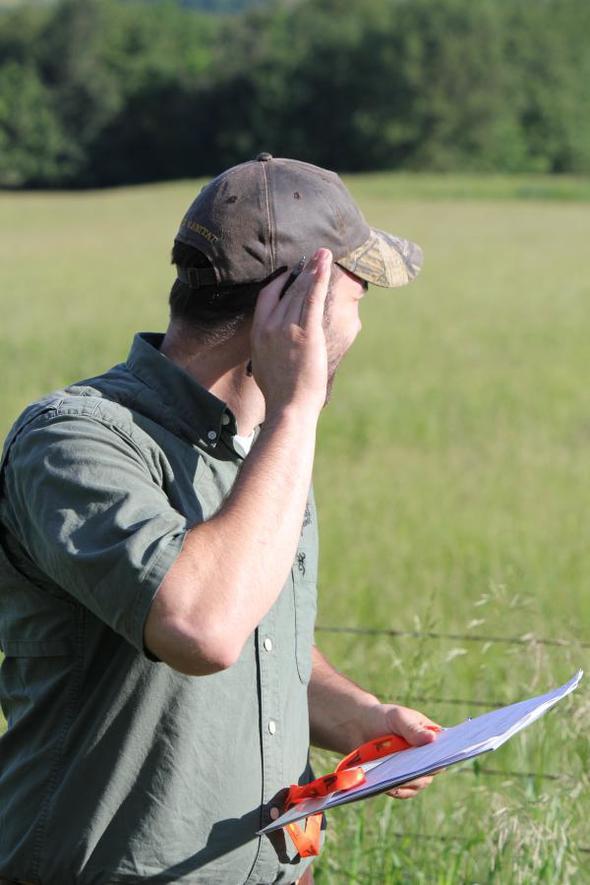
This volunteer stops and listens for bird
calls during early morning breeding bird surveys conducted in June. More volunteers are needed. For more information or to
volunteer, contact Janet Haslerig at Janet.Haslerig@mdc.mo.gov
or 573-522-4115, ext. 3198.
|