|
The
Minnesota Pollution Control Agency (MPCA) is seeking applications for projects
that will reduce nonpoint source pollution in Minnesota’s lakes, rivers, and
streams. Funding for selected projects will be provided by the Federal Clean
Water Act Section 319 (Section 319) grant funds. The Request for Grant
Applications is open until Wednesday, March 9.
The MPCA anticipates about $2.5 million will be available this
year, contingent upon Congressional appropriation.
Only Total Maximum Daily Load (TMDL) and Watershed Restoration
and Protection Strategies (WRAPS) implementation projects will be funded.
Eligible applicants must have a TMDL implementation plan or WRAPS approved by
the MPCA by Feb. 29, 2016. No nonpoint source development, education or applied
research projects (DER) projects will be funded this year.
Other changes this year include no maximum limit on funding
requests and the local cash or in-kind match has been reduced to 40 percent.
Grant funds are limited and MPCA urges proposers to request only
those funds needed to complete a project by Aug. 31, 2020.
Applications and other information are available on the MPCA website.

The Minnesota Dept.
of Agriculture (MDA) is accepting proposals through March 4 for funding research that quantifies the
effectiveness of agricultural conservation practices related to nutrient source
reduction, off-movement, and treatment. As funded by the Clean Water Fund, the
department will award contracts to select
scientists and researchers to conduct research related to impaired waters in
agricultural watersheds in Minnesota.
Applications must be submitted using the format
prescribed in the proposal instructions. To request proposal instructions and application
materials, please email Heidi
Peterson, impaired waters technical coordinator for MDA. Additional
information, including research priorities, is available in the February 1, 2016 State Register (page 38 of the PDF or page
934 of the Register).
|
 While registrations filled quickly for the Governor’s Water Summit later this month, the online survey is still open. Minnesotans are
encouraged to take the survey regardless of whether they plan to attend the
summit. The information and input gathered from this survey will help inform
the Administration and Legislature on Minnesota’s water quality challenges and
possible solutions.
The Feb. 27 summit, being held in St. Paul, will focus public attention
on the serious challenges facing Minnesota’s water supplies – in both rural and
urban areas of the state – and continue statewide dialogue around steps needed
to address those challenges. It will bring together water quality experts, farmers,
legislators, regulators, the business community, members of the public, local
leaders, and a wide variety of other stakeholders.
|
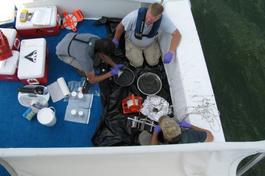
In
its most recent report on the health of coastal waters, the U.S. Environmental
Protection Agency (EPA) included assessments of the Great Lakes for the first
time. For the Great Lakes, including Lake Superior in northeast Minnesota, indices
showed:
- Fair
health for water quality and fish tissue contaminants
- Fair
to poor health for benthic (bottom of a water body) and coastal habitat
- Poor
health for sediment quality
Overall,
more than half of the nation's coastal and Great Lakes near-shore waters are
rated good for biological and sediment quality, while about one-third are rated
good for water quality, according to the 2010 National Coastal Condition
Assessment released in January 2016. In almost all coastal waters, however,
contaminants in fish tissue pose a threat to sensitive predator fish, birds,
and wildlife.
The
National Coastal Condition Assessment is part of a series of National Aquatic
Resource Surveys designed to advance the science of coastal monitoring and
answer critical questions about the condition of waters in the United States.
More than half the nation’s population lives near coastal waters, and that
number is increasing every year, making it important to understand the
condition of these highly productive and fragile habitats so they can
be properly managed and protected.
For
the full report and summary fact sheets, visit the EPA
website.
|

The Cannon
River Watershed Partnership will wrap up its series of meetings on
Watershed Restoration and Protection Strategies (WRAPS) on Feb. 17, from
9 a.m.-noon, at South Central Technical College in Faribault. This meeting will
conclude a 9-month process to gather input from citizens and watershed
professionals (photo at right).
Content of the draft WRAPS document will be available for review
and comment at the meeting, along with content of the draft Total Maximum Daily
Load (TMDL) reports for various lakes and streams. An official public notice
will follow this spring, providing additional time to comment on the draft
documents.
Notes and presentations from the series of meetings are
available on the CRWP’s
website.
The Cannon River watershed is located south of the
Twin Cities and encompasses areas of Dakota, Goodhue, Le Sueur, Steele, Rice
and Waseca counties. The watershed drains about 1,460 square miles through two
main channels, the Cannon and Straight Rivers, to the Mississippi at Red Wing.
It includes 90 lakes and 107 wetlands of 10 acres or more in size. More than
70% of the land area is in cultivation.
|

The fourth workshop for the Hawk Creek WRAPS project drew nearly
80 participants, many grower-members of the Southern Minnesota Beet Sugar
Co-op (photo at right). Since most had not attended the previous three meetings, the Jan. 27
meeting at the Clara City community center began with an overview of the Watershed Restoration and Protection Strategy,
and a video with farmer and soil health advocate Gabe
Brown.
Attendees provided input to a variety of questions using the
electronic “clicker” survey keypads. Issues receiving strong support included:
Farm groups as leaders, demonstration projects, and more networking between
agency staff and farmers.
With pollutant reduction targets set at past workshops, this
meeting collected ideas and input about the best tools to use. The Hawk Creek
WRAPS report is scheduled for completion in 2016.
Everyone is invited to the Hawk
Creek Watershed Project annual meeting Feb. 24 in Willmar at
the MinnWest Technology Campus. There will be a review of Hawk Creek projects,
and a presentation by Don Reicosky, a soil health expert recently retired from
the USDA Agricultural Research Station in Morris. To RSVP contact Heidi
Rauenhorst, Hawk Creek Watershed Project coordinator, 320-523-3666, heidi@hawkcreekwatershed.org.
|
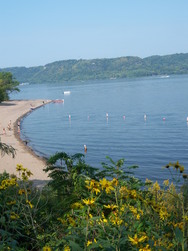 Now that a custom water quality standard is in place for
Lake Pepin, the MPCA is working again on the Lake
Pepin TMDL for nutrients. The custom or site-specific standard is designed
to prevent harmful algal blooms in the lake.
Lake Pepin, a natural lake, is the widest part of the
Mississippi River, bordered by Minnesota on the west and Wisconsin on the east.
It is located about 60 miles downstream of St. Paul, just south of the
confluence of the St. Croix and Mississippi rivers. The lake is 21 miles long,
averages 1.7 miles wide and covers 29,295 acres. It has a maximum depth of 60
feet and an average depth of 21 feet.
About 48,634 square miles – roughly half of Minnesota’s
total land area plus a small portion of Wisconsin – including the Upper
Mississippi, St. Croix and Minnesota rivers, drain into the Lake Pepin.
Lake Pepin was originally part of a combined TMDL study with
the South Metro Mississippi that is impaired by total suspended solids. The agency spilt the study at the
recommendation of stakeholders and science advisers. While the South Metro
Mississippi study proceeded and recently went to the EPA for approval, the
agency suspended work on the Lake Pepin TMDL while developing a site-specific
standard for the lake. The EPA approved the research-based standard, and after
a legal challenge, the state of Minnesota adopted it in 2014. The new standard
for Lake Pepin to prevent harmful algal blooms is:
- 100 micrograms per liter for total phosphorus; and
- 28 micrograms per liter for chlorophyll-a
The MPCA believes these criteria will provide protection of
aquatic recreational uses for Lake Pepin and the downstream river pools, and
should be applicable over the range of flows for which the criteria were
developed.
For perspective, the average level of total phosphorus in Lake
Pepin from 2000-2009 was 171 micrograms per liter. Reductions in wastewater
phosphorus loading over this same period resulted in Mississippi River
concentrations approaching 150 micrograms per liter in 2009. From 2000-2009,
the average of chlorophyll-a was 30 micrograms per liter.
Achieving the site-specific standard for Lake Pepin will require
reductions in phosphorus and chlorophyll export in upstream watersheds. The TMDL study will also address sections of
the Minnesota and Mississippi rivers that impact Lake Pepin.
“We have a wealth of technical information and a wealth of
stakeholder input. The intent now is to synthesize all the information and
input into one document for review,” said Justin Watkins, MPCA watershed
project manager.
|
The sixth Minnesota River Congress will be held Thursday, March
10 at the New Ulm Event Center. The citizen-led group focusing on the
natural resource and economic health of the Minnesota River basin will take
action on bylaws, remaining board elections, and annual meeting date. The
measures were advanced by the Congress Action Board meeting Jan. 26 in New Ulm.
“We’ve come a long way
since the first Congress back in June of 2014,” said Scott Sparlin, of the
Coalition for a Clean Minnesota River and Congress facilitator. “After the old
Minnesota River Board disbanded, a lot of people still believed that we needed
some type of group focused on the entire Minnesota River basin.”
More information about
the Congress including a list of Action Board categories is available online at
www.watershedalliance.blogspot.com/. More details about the sixth Congress March
10 will be announced later. For more information contact Scott Sparlin,
507-276-2280, sesparlin@gmail.com.
The Environmental
Initiative is accepting nominations through Feb. 19 for its annual awards
program. Each year Environmental Initiative honors innovative projects that
have achieved extraordinary results by harnessing the power of partnership. Finalists
for the 2016 Environmental Initiative Awards will be announced in late March.
Mark your calendars for the dinner and awards ceremony to be held on Thursday,
May 26, at Nicollet Island Pavilion in Minneapolis.
The
MPCA and Minnesota Erosion Control Assoc.
will hold “MS4 Permit Workshops” in Rochester on Feb. 25 and in Brainerd on
March 24, from 8:30 a.m.-3:30 p.m. The training at both locations will focus on the inspection
aspects of meeting municipal
separate storm sewer system (MS4)
permit requirements. Highlights include prioritizing construction sites,
pre-inspection activities, completing inspections, post-construction
activities, non-compliance, MS4 system inspections, and incorporating inspections
into everyday activities. Registration
is available online. The fee is $60 for MECA members and $85 for
non-members, and covers training, lunch and breaks. Participants will receive a
certification of completion.
|




