|
If regional management of the red snapper fishery in the
Gulf of Mexico is going to be realized any time soon, it’s apparently not going
to be through the Gulf of Mexico Fishery Management Council.
The Gulf Council met recently in Orange Beach, Ala., and
Amendment 39, which has to do with regional management, was tabled after it
lost support from the representatives from the five Gulf states.
Chris Blankenship, Director of the Marine Resources Division
of the Alabama Department of Conservation and Natural Resources (ADCNR), said
the reason the states abandoned Amendment 39 was because changes to the
document were so widespread that it had very little resemblance to the
amendment as originally proposed.
“From the states’ perspectives, it really got to the point
in the document that it was so far away from where we originally started with
the idea of regional management that it wasn’t going to be much of a benefit,”
Blankenship said.
Blankenship said the National Marine Fisheries Service
(NMFS) had included provisions that really wouldn’t afford states many
management options.
“NMFS has what they call a Conservation Equivalency Plan,”
he said. “The states would have to submit that plan to NMFS, and they would
either OK our management regime or not. If they had a problem with our plan, we
had no recourse. It would go back to being managed by the feds. It really
didn’t give us the flexibility we wanted in regional management.
“Basically, what it got down to was we would be able to pick
the days we wanted to fish. That was about it. They would give us a quota. They
would only allow us to do certain things to manage it as far as daily catch
rates and things like how we measure those catch rates. It just got to the
point where it was not going to be advantageous for the states to pursue it.”
Blankenship said the states will continue to work through
Congress for legislation that would give the Gulf states true regional
management of red snapper.
The directors of the marine resources divisions of the Gulf
states, including Blankenship, are in Washington this week to try to keep
regional management a priority for the perspective leaders in Congress.
“For the State of Alabama, what we would like to see is
where we do the stock assessment and we manage the fish off the coast of
Alabama,” Blankenship said. “We think if we can manage red snapper from start
to finish that we can adequately protect the fish stock while allowing access
for the fishermen, both charter and recreational as well as commercial. We
think we can make a better system for everybody.”
Capt. Johnny Greene, who runs the charter boat Intimidator
out of Orange Beach, is chairman of the Gulf Council’s Reef Fish Committee.
Greene had a similar assessment of Amendment 39.
“It was a good concept, but when you have five extremely
competitive states, it’s hard to get everybody to agree on allocation,” Greene
said. “I think there was good intent, but it did stray far away from the
initial concept.”
NMFS won’t likely announce the 2016 red snapper season dates
until April, but Blankenship expects the dates to be similar to last year
because the quota has changed very little. In 2015, private recreational
anglers had a 10-day season, while charter boats fished for 44 days.
Last year was the first time the private recreational
anglers and charter boats had separate seasons, which prompted a lawsuit from
the Coastal Conservation Association (CCA) challenging the sector separation.
However, the suit was unsuccessful when a federal judge ruled the Gulf Council
had the authority to make the changes.
Despite catching about 35 percent of the red snapper landed
from the Gulf of Mexico, Alabama has only about 100 of the 1,400 charter boats
with Gulf reef fish permits.
One thing the Gulf Council did at a previous meeting was to
reallocate the quota, previously 51 percent for the commercial sector and 49
percent for the recreational sector, which includes charter boats and private
recreational anglers. The new allocation, which has been published in the
Federal Register and is awaiting final approval from the U.S. Commerce
Department, would give the recreational sector 51.5 percent of the quota and
the commercial sector 48.5 percent. The total quota for 2016 is 13.96 million
pounds. NMFS is withholding 352,000 pounds from the commercial sector quota
should the proposed reallocation get final approval.
One piece of the news that benefits Alabama was a provision
in the federal legislation that extends Alabama state waters to 9 miles from
the previous 3-mile limit. Sen. Richard Shelby spearheaded the effort to make
all five Gulf states’ fisheries management boundaries the same at 9 miles.
“With the 9 miles of state waters, the department (ADCNR)
will have more options for managing the fishery than before,” Blankenship said.
“The 9-mile limit puts us on equal footing with Florida and Texas. More
importantly, it makes it easier for the fishermen because we have a consistent
9-mile boundary. For the last few years, there has been a dispute between the
state and federal governments as to where state jurisdiction ends and the
federal jurisdiction begins.
“Senator Shelby was able to include the legislation in the
omnibus spending bill, and state officials are working with our congressional
delegation to make that 9-mile limit permanent.”
In other Gulf fisheries action, the Gulf Council moved
forward with an amendment that would increase the daily creel limit on king
mackerel from two fish per person to three fish per person. Blankenship said
recreational anglers have not reached the quota on king mackerel for several
years. The proposed king mackerel limit still has to go out for public comment
and won’t likely change until the 2017 season.
Also, in a previous Council meeting, the size limit on
amberjack was increased from 30 inches fork length to 34 inches fork length
(from tip of nose to fork in the tail).
 |
|
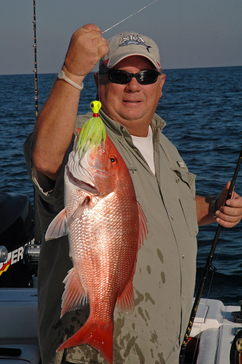
Although anglers are reporting an abundance of red snapper, it appears the snapper season is again going to be a short one for the private recreational anglers.
Photo by David Rainer
|
You are receiving this message as a subscriber to DAVID RAINER'S WEEKLY COLUMN or RED SNAPPER SEASON INFORMATION.
Manage Subscriptions to change your preferences.
|