|
As many Alabama offshore anglers will attest, the results
from the red snapper catch data is the same old song, second verse.
When the mandatory Red Snapper Reporting System was
implemented for the 2014 season, the Alabama Marine Resources Division had a
pretty good idea that the catch numbers compiled by the NOAA Fisheries was
significantly inflated. The catch data for the 9-day 2014 season reported
through Alabama’s “Snapper Check” was 455,522 pounds, while the feds estimated
the catch at a whopping 1,227,469 pounds.
The discrepancy between the Alabama red snapper catch data
and the federal catch data was recently confirmed with the 2015 numbers.
Keep in mind the 2015 season was different because of sector
separation. The private recreational anglers had a 10-day season. The charter
boats with a federal reef fish permit were allowed to fish 44 days.
Still, the discrepancy was significant. The federal catch
estimate was 2,355,481 pounds. Marine Resources estimated the catch off Alabama
at 56 percent less than the federal estimate at 1,045,042. The average-size red
snapper landed was more than 8 pounds.
“We continued the Red Snapper Reporting Program for a second
year to compare it to the federal MRIP (Marine Recreational Information
Program),” said Chris Blankenship, Director of the Alabama Marine Resources
Division. “Last year, the results showed that Alabama caught about two-and-a-half
times less red snapper than the federal government estimated we caught.
“Where that’s important is the quota is set before the
season, and that’s how they determine the number of days for the season. If
they are overestimating what’s been landed, our snapper season potentially
could have been two-and-a-half times longer if they had used Alabama’s
information.”
Blankenship said even though the parameters changed because
of the sector separation, Marine Resources was interested to see if that
discrepancy between Alabama numbers and federal numbers would be similar for
2015.
“This year, the federal program estimated there was more
than twice the number of red snapper landed than what the Alabama program
estimated,” he said.
The reason Blankenship is confident in the Alabama numbers
is because of the collection of data through the mandatory Red Snapper
Reporting Program and the deployment of Marine Resources personnel to conduct
checks at the public boat ramps and marinas, as well as on-the-water checks by enforcement
personnel.
“We end up with a correction factor for the ones that were
not reported,” he said. “We use that to come up with the final numbers. It’s a
much less complicated system than what the federal government uses, and we feel
ours is much more accurate.
“We have cameras at the public boat launches; we do vessel
counts on how many boats launched during red snapper season. We do this to
compare the numbers used by the Alabama reporting program or the MRIP data.
What we found was the number of vessels launched very closely corresponds with
what the Alabama red snapper program reported. We think that is important
validation for our program.”
Blankenship also said the MRIP system is still using a
telephone survey of coastal households and extrapolating the data.
“It’s obvious to us when we look at the results from that
telephone survey that they are overestimating the amount of effort, the number
of fishing trips for the state of Alabama,” Blankenship said. “We are
attempting to work with the MRIP team to see what’s causing the difference in
data.
“They have been very anxious to see how we have calculated
our results from the Alabama Snapper Check, but they have not been as open to
show how they come up with their numbers. We’re trying to work through those
difficulties. We don’t have anything to hide. We are glad to show how our
system works and how we came up with our numbers. It’s not complicated, and we
feel it’s very accurate. We want to be able to look under the hood of the MRIP
program, and we think it will help them develop a more accurate estimate of the
catch, not only in Alabama but nationwide.”
Blankenship said one example of MRIP data that cannot be
accurate came from Mississippi.
“When you look at the landings on the NOAA MRIP website for
the private recreational season in Mississippi and the federal estimate of
their catch, for the 10-day red snapper season in June, the federal MRIP system
estimated there was not a single red snapper landed in the state of
Mississippi,” Blankenship said. “So in Alabama, the feds estimated we caught
more than 2 million pounds of red snapper, and in Mississippi, they estimated
they caught zero red snapper during the same time period. This just shows the
MRIP system obviously has some flaws.
“That’s why we feel it is so important for the feds to use
numbers from Alabama Snapper Check because our numbers are much more accurate.”
The current federal quota for the recreational sector has a
20-percent buffer built in to account for overages. Blankenship said the best
way to get rid of that ridiculously large buffer is to have more accurate catch
data.
“The best way to get that 20-percent buffer back is to have
regional management for either a portion of the quota or true management of red
snapper where we do the stock assessment and set the quota,” he said. “We feel
like with regional management we can get more days for the private recreational
anglers and more days for the charter boats.”
The Gulf of Mexico Fishery Management Council is considering
Amendment 39 that would give the five Gulf States regional management of the
red snapper fishery.
A public hearing on the amendment was held in Mobile Tuesday
night. The full Gulf Council will consider Amendment 39 at its next meeting,
which is scheduled for January 25-29, 2016, at Perdido Beach Resort in Orange
Beach, Ala.
“The reason Amendment 39 is important is evident in our red
snapper reporting numbers,” said Blankenship. “Alabama currently supports
Amendment 39 because we feel like we can do a much better job managing this red
snapper fishery than is currently being done by the federal government and get
our anglers more days to fish.”
Blankenship said Marine Resources is in the process of doing
a stock assessment off the coast of Alabama and will hopefully have the results
by the end of the year. The early numbers look good.
“The snapper stock seems to be very healthy even after the
season,” he said. “Whether we caught a million pounds as Alabama estimates or
2.3 million pounds as the federal government estimates, we’ve been out there
doing research since the season ended.
“I can say there is no shortage of legal-size red snapper
off the coast of Alabama.”
 |
|
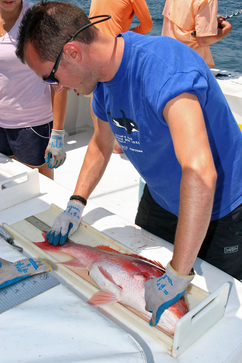
Ongoing research on the red snapper population
off of Alabama indicates a healthy, vibrant stock.
Photo by David Rainer
|
You are receiving this message as a subscriber to DAVID RAINER'S WEEKLY COLUMN or RED SNAPPER SEASON INFORMATION.
Manage Subscriptions to change your preferences.
|